
Retirement sounds relaxing—until the days start blending together. That’s where indoor hobbies for retired men can make a real difference, turning empty hours into something meaningful, engaging, and even energizing.
This guide goes beyond the usual “try reading or gardening” advice. You’ll discover practical hobbies that actually stick, why some activities fail, and how to choose options that fit your lifestyle—especially if you’re spending more time indoors or living in a smaller space.
In This Article
When the Routine Disappears: Why Retirement Feels Longer Indoors
For decades, work provided structure—wake up, get ready, solve problems, interact with people. Once that disappears, the sudden openness can feel freeing… for a while.
Then something unexpected happens.
Days stretch out. Time feels slower. Even simple tasks lose their sense of urgency.
The Hidden Shift Most People Don’t Expect
Retirement doesn’t just remove work—it removes:
- Daily goals
- External accountability
- A sense of progress
Without those, it’s easy to drift into passive habits like watching TV or scrolling endlessly. That’s not rest—it’s understimulation.
Rest vs. Lack of Purpose
There’s a big difference between:
- Intentional rest → recharging, relaxing, enjoying time
- Unstructured time → boredom, restlessness, low motivation
Indoor hobbies work best when they replace structure with something meaningful, not just something to “pass the time.”
Not All Hobbies Work: What Most Lists Get Wrong
Search for hobby ideas, and you’ll find long lists that look impressive—but rarely work in real life.
Why? Because they ignore one critical factor: fit.
The Problem With Generic Hobby Lists
Most lists focus on what sounds good, not what feels right. That leads to:
- Starting a hobby and quitting after a week
- Buying equipment that collects dust
- Feeling frustrated instead of fulfilled
The Real Filter: Purpose vs. Distraction
A hobby that sticks usually has at least one of these:
- A clear outcome (you build, fix, or create something)
- A sense of progress or improvement
- A feeling that your time is well spent
Hobbies that are purely passive rarely hold attention for long.
Matching Hobbies to Personality (Not Trends)
Instead of asking “What’s popular?”, ask:
- Do you enjoy working with your hands or your mind?
- Do you prefer quiet focus or light activity?
- Do you want something practical or creative?
A retired engineer might love restoring tools. A former teacher may enjoy writing or mentoring online. The right hobby reflects who you already are—it doesn’t force you to become someone else.
Indoor Hobbies for Retired Men That Build Something Real
Some of the most satisfying hobbies share one thing in common: you can see the result of your effort.
That sense of completion is powerful—and often missing in retirement.
Hands-On Projects That Create Real Results
These hobbies don’t require a full workshop or large space to get started:
- Small-scale woodworking
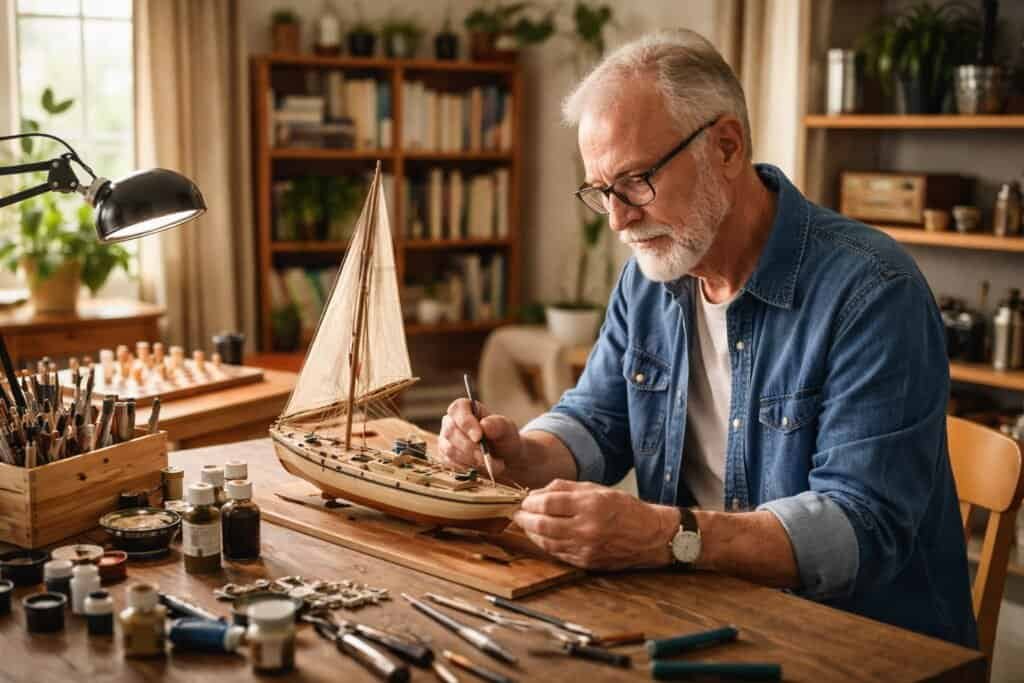
Build shelves, birdhouses, or simple furniture using compact tools. Even a corner workspace can be enough. - Model building
From airplanes to architectural kits, this hobby combines precision, patience, and creativity. - Restoring old items
Fixing vintage radios, tools, or furniture adds purpose—and sometimes even value.
Why “Making Things” Feels So Rewarding
Working with your hands does more than fill time. It:
- Creates a clear start-to-finish process
- Provides visible progress
- Gives a sense of ownership and pride
Many retired men find that building or restoring things brings back a feeling they had during their working years—solving problems and seeing results.
A Realistic Setup (Even Indoors)
You don’t need a garage or large workshop. Start with:
- A foldable table or compact desk
- Basic tools (manual or small electric)
- Storage bins to keep things organized
Even in a small home, these hobbies are surprisingly doable—and often more enjoyable because they stay simple and focused.
The Quiet Power of Skill-Based Hobbies (That Keep Your Brain Sharp)
Not every hobby needs to produce something physical. Some of the most valuable indoor hobbies for retired men are the ones that challenge your mind and keep it active over time.
Learning Something New—Without Pressure
Retirement removes deadlines, which makes it the perfect time to learn purely for enjoyment.
Consider:
- Learning a musical instrument (guitar, keyboard, harmonica)
- Chess or strategy games that reward long-term thinking
- Language learning through apps or books
- Deep dives into topics like history, science, or engineering
The key difference now? You’re learning because you want to, not because you have to.
Why Mental Hobbies Matter More Than You Think
Skill-based hobbies help:
- Maintain memory and cognitive function
- Improve focus and patience
- Create a sense of ongoing progress
Even 20–30 minutes a day can make a noticeable difference in how sharp and engaged you feel.
Making It Stick Without Burnout
The mistake most people make is going too hard, too fast.
A better approach:
- Start with short sessions (15–20 minutes)
- Focus on consistency over intensity
- Track small wins (a song learned, a puzzle solved)
Progress builds quietly—but it adds up in a way that feels deeply satisfying.
The Ones That Surprise People: Low-Effort Hobbies That Stick
Some hobbies don’t look exciting at first glance—but they end up becoming daily habits you genuinely look forward to.
These are often the most sustainable indoor hobbies.
Simple Ideas That Turn Into Long-Term Habits
- Indoor gardening or hydroponics
Growing herbs or small plants indoors creates a daily routine with visible growth. - Cooking experiments
Trying new recipes, techniques, or cuisines turns meals into creative projects. - Home-based photography
Capturing everyday objects, textures, or light can become surprisingly engaging.
Why “Low-Effort” Often Wins
High-effort hobbies can feel exciting at the start—but they’re harder to maintain.
Low-effort hobbies:
- Require less setup
- Fit easily into daily routines
- Feel relaxing instead of demanding
That combination makes them more likely to stick for months—or years.
The Hidden Benefit: They Blend Into Daily Life
You don’t need to “set aside time” for these hobbies.
- Watering plants becomes a morning ritual
- Cooking becomes creative expression
- Taking photos becomes a way of seeing differently
They quietly improve your day instead of competing with it.
What to Avoid: Hobbies That Quickly Turn Into Frustration
Not every hobby is a good fit—and choosing the wrong one can kill motivation fast.
Recognizing what doesn’t work is just as important as finding what does.
Common Traps That Lead to Burnout
- Overly complex hobbies
Activities with steep learning curves can feel overwhelming early on. - Expensive setups
Investing too much upfront creates pressure to “stick with it”—even if you don’t enjoy it. - Clutter-heavy hobbies
Projects that take over your living space often become stressful instead of enjoyable.
Passive Habits Disguised as Hobbies
It’s easy to mistake these for hobbies:
- Watching endless TV
- Scrolling social media
- Mindless gaming without challenge
They pass time—but rarely leave you feeling fulfilled.
Warning Signs You’ve Chosen the Wrong Hobby
Pay attention if you:
- Keep putting it off
- Feel frustrated more than engaged
- Dread setting it up or cleaning afterward
A good hobby should feel like something you want to return to—not something you have to force.
A Better Way to Test Before Committing
Instead of going all-in:
- Try a hobby for 1–2 weeks with minimal investment
- Borrow tools or start with basic versions
- Focus on how it feels, not how good you are at it
The right hobby won’t feel perfect—but it will feel worth continuing.
Turning Hobbies Into a Daily Rhythm (Without It Feeling Like Work)
The difference between a hobby you try once and one that becomes part of your life often comes down to how you fit it into your day.
Too rigid, and it feels like a job. Too loose, and it fades away.
Build a Flexible Structure That Works for You
Instead of scheduling exact times, think in blocks of intention:
- Morning → something light and enjoyable (watering plants, reading, short practice)
- Afternoon → more focused activity (building, learning, projects)
- Evening → relaxing or social hobbies (games, music, conversations)
This creates a rhythm without pressure.
Mix Different Types of Hobbies
A balanced routine usually includes:
- Hands-on activity (building, fixing, crafting)
- Mental stimulation (learning, puzzles, strategy)
- Relaxation (reading, music, light hobbies)
Switching between them keeps things fresh and prevents burnout.
A Real-Life Example
A simple daily flow might look like:
- 20 minutes of guitar practice in the morning
- An hour working on a small project after lunch
- Chess or reading in the evening
Nothing intense—just consistent and enjoyable.
That’s the goal: a rhythm you naturally return to, not one you have to force.
Indoor Hobbies That Fit Small Homes and Limited Space
You don’t need a large house—or even a dedicated room—to enjoy meaningful hobbies. In fact, many indoor hobbies for retired men work better in smaller, more focused spaces.
Smart Ways to Set Up a Hobby in a Small Area
- Use a foldable table or wall-mounted desk
- Store tools in stackable bins or vertical shelves
- Keep projects modular so they can be packed away easily
A compact setup reduces friction—you’re more likely to start when everything is simple and accessible.
Low-Mess, Space-Friendly Hobby Options
If space is limited, these work especially well:
- Model building or small crafts
- Drawing, journaling, or writing
- Digital hobbies (photo editing, music, research)
- Light repair or restoration work
They require minimal space but still provide depth and engagement.
Why Smaller Spaces Can Actually Help
A smaller environment:
- Forces you to stay organized
- Reduces distractions
- Makes it easier to build consistent habits
For many people, this leads to more productivity—not less.
If you’re living in a compact home or exploring downsized living, hobbies like these naturally fit into a simpler, more intentional lifestyle.
From Hobby to Side Income (If You Want It — Not If You Don’t)
Some hobbies naturally open the door to earning a little extra money. Others are better left as pure enjoyment.
The key is knowing the difference—and choosing intentionally.
Hobbies That Can Turn Into Income
Certain activities have clear earning potential:
- Selling handmade items (woodwork, crafts, restored goods)
- Offering services (repairs, tutoring, consulting)
- Creating digital products (guides, photos, niche content)
Even small earnings can add a sense of purpose and validation.
When Monetizing Helps—and When It Hurts
Turning a hobby into income can:
- Add motivation
- Create structure
- Make your work feel valued
But it can also:
- Introduce pressure and deadlines
- Reduce enjoyment
- Turn a relaxing activity into “work” again
A Simple Rule to Follow
Ask yourself:
- Would I still enjoy this if no one paid me?
If the answer is yes, you’re in a good position to monetize carefully.
If not, it’s better to keep it as a hobby—and protect the enjoyment it brings.
Keep Expectations Grounded
Not every hobby needs to become a business.
Sometimes the real return is:
- A better daily routine
- A sharper mind
- A stronger sense of satisfaction
That’s often far more valuable than income.
The Social Side Most People Miss
Many indoor hobbies for retired men seem solitary on the surface—but they don’t have to stay that way.
A lack of social interaction is one of the biggest challenges in retirement, and hobbies can quietly solve that problem.
Solo Doesn’t Have to Mean Isolated
Even individual hobbies can create connection:
- Sharing progress in online communities
- Joining hobby-specific forums or groups
- Participating in friendly competitions (chess, photography, model building)
You’re still working independently—but with a sense of shared interest and belonging.
Where Connection Naturally Happens
Look for:
- Facebook groups or niche forums
- Local community centers or clubs
- Online classes with discussion elements
These spaces turn hobbies into conversation starters, not just time-fillers.
Why This Matters More Than You Think
Connection isn’t just about socializing—it’s about:
- Feeling seen and valued
- Staying mentally and emotionally engaged
- Avoiding the slow drift into isolation
The right hobby doesn’t just occupy your time—it keeps you connected to the world.
A Simple Way to Choose the Right Hobby (Without Overthinking It)
Too many options can lead to doing nothing at all. Instead of overanalyzing, use a simple filter to find what actually fits.
The “3-Question Filter”
Before committing to any hobby, ask:
- Do I enjoy the process?
Not just the result—but the actual time spent doing it. - Can I realistically do this indoors, regularly?
If it’s inconvenient, it won’t last. - Do I feel better after doing it?
More relaxed, focused, or satisfied?
If a hobby passes all three, it’s worth continuing.
Test Without Commitment
Avoid the common trap of going all-in too early.
Try this instead:
- Start with basic tools or free resources
- Give it 1–2 weeks of consistent effort
- Evaluate based on experience—not expectations
This removes pressure and helps you make a more honest decision.
When Motivation Drops: How to Stay Interested Long-Term
Every hobby feels exciting at the beginning. The real challenge is what happens after the novelty wears off.
Why Interest Fades So Quickly
Motivation often drops because:
- Progress slows down
- The activity becomes repetitive
- Expectations were too high at the start
This is normal—not a sign to quit.
Simple Ways to Keep Things Engaging
- Set small, achievable goals (finish a model, learn a song, complete a project)
- Change the format slightly (new techniques, different difficulty levels)
- Rotate between 2–3 hobbies to avoid burnout
Variety keeps your brain interested without losing consistency.
Focus on Progress, Not Perfection
Perfection creates pressure. Progress creates momentum.
Instead of asking:
- “Am I good at this?”
Ask:
- “Am I better than last week?”
That shift keeps hobbies enjoyable—and sustainable.
Rethinking Retirement: It’s Not About Staying Busy
The goal of retirement isn’t to fill every hour. It’s to build a life that feels satisfying on your terms.
The right indoor hobbies help you:
- Stay mentally and physically engaged
- Create structure without stress
- Feel a sense of purpose again
It’s not about doing more—it’s about doing what matters.
Even small, consistent activities can reshape your day in meaningful ways.
FAQ: Indoor Hobbies for Retired Men
What are the best indoor hobbies for retired men with limited mobility?
Options like reading, puzzles, model building, music, and indoor gardening are excellent because they require minimal physical strain but still provide engagement and purpose.
How many hobbies should a retired man have?
Most people do well with 2–3 hobbies that cover different needs—mental stimulation, hands-on activity, and relaxation.
Can indoor hobbies really improve mental health after retirement?
Yes. Engaging hobbies reduce boredom, improve focus, and create a sense of accomplishment, which supports overall mental well-being.
What are inexpensive indoor hobbies to start with?
Reading, journaling, drawing, cooking, and basic DIY projects are affordable and easy to begin without large upfront costs.
Is it too late to learn new skills after retirement?
Not at all. Many people find it easier to learn after retirement because there’s less pressure and more time to focus.
Start Small—But Start Today
You don’t need the perfect hobby or a detailed plan.
Pick one idea that feels interesting. Try it for a week. Adjust as you go.
The goal isn’t to find the “best” hobby—it’s to find something that makes your day feel a little more meaningful.
That’s where everything starts.
Staying connected and mentally active plays a huge role in enjoying retirement. This guide from the National Institute on Aging offers practical tips on maintaining brain health and social well-being:
https://www.nia.nih.gov/health/cognitive-health-and-older-adults
