
Designing the right stair solutions in tiny house living can make or break your space. In a home where every square foot matters, stairs aren’t just a way to reach the loft—they’re an opportunity to add storage, improve flow, and enhance everyday comfort.
This guide walks you through the best stair options, space-saving ideas, practical design tips, and real-world considerations so you can choose a solution that fits your layout and lifestyle perfectly.
In This Article
Why Stair Design Matters More in a Tiny House Than You Think
Stairs in a traditional home are often overlooked. In a tiny house, they become one of the most important design decisions you’ll make.
A poorly planned staircase can:
- Eat up valuable floor space
- Make your loft hard to access
- Limit storage opportunities
- Create safety concerns, especially for kids or seniors
A well-designed stair solution, on the other hand, does much more than connect levels. It becomes multi-functional furniture—a storage unit, a design feature, and a daily-use necessity all in one.
The Real Challenge: Space vs. Comfort
Tiny house owners constantly juggle two competing priorities:
- Saving space
- Maintaining usability
Steep stairs might save room, but they can quickly become frustrating—or even unsafe—when used multiple times a day.
That’s why the best stair solutions in tiny house design always strike a balance between:
- Footprint efficiency
- Ease of use
- Safety and stability
Stair Solutions in Tiny House: What Are Your Real Options?
There’s no one-size-fits-all staircase for tiny homes. The right choice depends on your layout, lifestyle, and how often you’ll use the loft.
Here’s a quick breakdown of the most common stair solutions in tiny house designs:
Traditional Stairs
- Compact versions of standard staircases
- Comfortable and familiar
- Take up the most space
Alternating Tread Stairs
- Also known as ship ladders
- Designed with staggered steps
- Much steeper but more space-efficient
Ladder-Style Access
- The simplest and most compact option
- Often removable or vertical
- Best for occasional use
Hybrid Solutions
- A mix of stairs and ladders
- Convertible or foldable designs
- Ideal for ultra-tight layouts
Quick Comparison Table
| Stair Type | Space Usage | Comfort Level | Best For |
| Traditional Stairs | High | High | Full-time living |
| Alternating Tread | Medium | Medium | Small but frequently used lofts |
| Ladder | Low | Low | Occasional access |
| Hybrid | Very Low | Varies | Flexible or multi-use spaces |
Choosing between these options comes down to how you prioritize space, safety, and daily convenience.
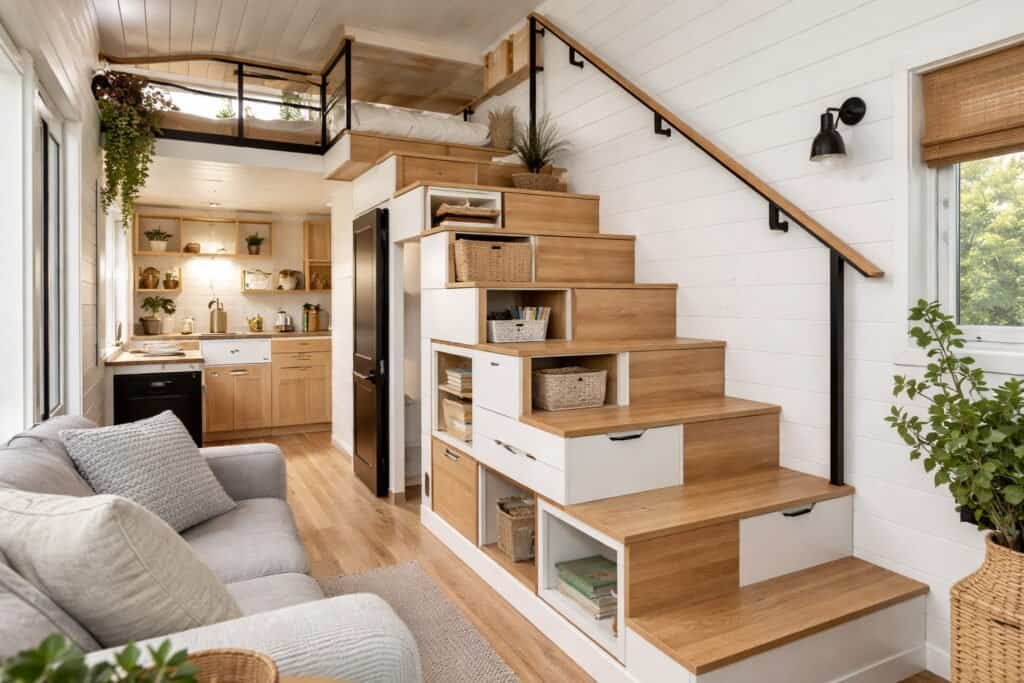
Traditional Staircases (Yes, They Can Work in Tiny Homes)
It might seem counterintuitive, but traditional staircases can absolutely work in a tiny house—when designed thoughtfully.
Why Some Tiny Homeowners Still Choose Standard Stairs
Despite taking up more room, traditional stairs offer clear advantages:
- Maximum comfort for daily use
- Safer for all ages, including children and older adults
- Easier to carry items up and down
- Adds a sense of normalcy and resale appeal
For full-time tiny living, especially if the loft is your primary bedroom, comfort often outweighs space savings.
Smart Ways to Make Them Tiny-House Friendly
A standard staircase doesn’t have to be bulky. Creative design can make it far more efficient:
- Reduce width slightly while maintaining stability
- Integrate built-in storage under each step
- Combine stairs with shelving or cabinetry
- Align stairs along a wall to preserve open floor space
When Traditional Stairs Make the Most Sense
This option works best if:
- You live in the tiny house full-time
- You use the loft daily
- Safety and ease of movement are top priorities
- You have slightly more floor space to work with
Choosing traditional stairs is less about following convention and more about investing in long-term comfort and usability.
Space-Saving Stair Solutions in Tiny House Designs
When square footage is tight, space-saving stair solutions in tiny house layouts become essential. These designs prioritize efficiency without completely sacrificing usability.
Alternating Tread Stairs (Ship Ladders)
Alternating tread stairs are one of the most popular compact options. Each step is staggered, allowing for a steeper angle while still giving your feet proper placement.
Why they work:
- Require significantly less horizontal space
- Easier to climb than a vertical ladder
- Surprisingly comfortable once you get used to them
Trade-offs:
- Not ideal for small children or seniors
- Requires attention while climbing (not “autopilot” friendly)
Spiral Staircases
Spiral stairs bring a stylish, compact footprint to tiny homes.
Advantages:
- Minimal floor space usage
- Visually striking design element
- Works well in corner placements
Limitations:
- Harder to carry items up and down
- Can feel cramped depending on diameter
- Not always loft-friendly due to headroom constraints
Floating Stairs
Floating stairs create a modern, open feel—perfect for avoiding visual clutter in small interiors.
Key benefits:
- Makes the space feel larger and airier
- Can be customized to fit tight layouts
- Works well with minimalist interiors
Things to consider:
- Needs strong structural support
- May require railings for safety
- Often more expensive to build
Foldable or Retractable Stairs
For ultra-compact homes, foldable stairs are a clever solution.
Best features:
- Can be tucked away when not in use
- Ideal for guest lofts or secondary spaces
- Maximizes floor flexibility
Downside:
- Less convenient for everyday use
- Not as sturdy as fixed stairs
Pro Tip:
If your loft is used daily, prioritize ease of use over extreme space-saving. A slightly larger staircase often pays off in long-term comfort.
Storage Stairs: The Smartest Tiny House Stair Solution?
If there’s one design that perfectly fits tiny living, it’s storage stairs. This approach turns every step into functional space—something tiny homes can’t afford to waste.
Why Storage Stairs Are a Game-Changer
Instead of losing space to a staircase, you gain:
- Hidden storage
- Better organization
- Cleaner, clutter-free interiors
This is one of the most practical stair solutions in tiny house design, especially for full-time living.
Popular Storage Stair Ideas
Pull-Out Drawers
- Perfect for clothes, tools, or kitchen items
- Keeps everything hidden and tidy
Open Shelving
- Great for books, décor, or daily essentials
- Adds personality to your space
Hidden Cabinets
- Ideal for bulkier items
- Can double as pantry or closet space
Lift-Up Steps
- Each tread opens like a box
- Maximizes deep storage potential
When Storage Stairs Make the Most Sense
This solution works best if:
- You’re struggling with limited storage
- You prefer a clean, minimalist interior
- Your stairs are a permanent fixture (not foldable)
Storage stairs also pair perfectly with broader tiny house storage ideas, helping you eliminate the need for extra furniture.
Loft Access: Stairs vs. Ladders (Which One Wins?)
Choosing between stairs and ladders is one of the biggest decisions in tiny house design. Each has clear advantages, but the “right” choice depends on how you live.
Safety Comparison
- Stairs: Stable, easier to climb, safer for all ages
- Ladders: Require balance and strength, higher risk of slips
For daily use, stairs almost always win in terms of safety.
Space Trade-Offs
- Ladders: Take up minimal space and can often be moved or stored
- Stairs: Require a permanent footprint but offer more functionality
If your layout is extremely tight, a ladder may be the only viable option.
Comfort in Daily Life
Think about how often you’ll use your loft.
- Multiple trips per day → stairs are worth it
- Occasional use → ladder can be perfectly fine
Climbing a ladder half-asleep or carrying items quickly becomes inconvenient.
When Ladders Still Make Sense
Ladders are a smart choice if:
- The loft is for guests or storage
- You need maximum floor space
- You’re designing a highly minimalist setup
How to Choose the Right Stair Solution for Your Tiny House
Choosing the right stair solutions in tiny house design isn’t about trends—it’s about how you actually live day to day. A beautiful staircase that’s awkward to use quickly becomes a daily frustration.
Start With These Key Factors
Available Floor Space
- Measure not just width, but how far the stairs extend into your living area
- Tight layouts benefit from compact or vertical designs
Ceiling Height
- Low ceilings limit your options
- Steeper stairs or alternating tread designs may be necessary
User Mobility
- Households with kids, seniors, or pets need safer, more stable stairs
- Avoid steep or narrow designs if accessibility matters
Frequency of Use
- Daily loft access → prioritize comfort
- Occasional use → space-saving options become more viable
A Simple Decision Framework
Use this quick guide to narrow down your choice:
- Full-time living + daily loft use → Traditional or storage stairs
- Moderate space + frequent use → Alternating tread stairs
- Very limited space + occasional use → Ladder or retractable stairs
- Need extra storage → Storage-integrated stairs
Think Beyond the Stairs Themselves
Your staircase should work with your entire layout, not against it.
Consider:
- Traffic flow (does it block pathways?)
- Natural light (does it create dark corners?)
- Multi-functionality (can it replace other furniture?)
The best designs feel like a natural extension of the home—not an afterthought.
Tiny House Stair Dimensions & Building Considerations
Even in tiny homes, stair design isn’t just about creativity. Proper dimensions and safety details make a huge difference in comfort and usability.
Recommended Stair Dimensions
While tiny houses often bend traditional rules, these guidelines help maintain comfort:
| Element | Recommended Range |
| Tread Depth | 8–10 inches (20–25 cm) |
| Riser Height | 7–9 inches (18–23 cm) |
| Stair Width | 24–30 inches (60–76 cm) |
| Headroom Clearance | Ideally 6’2” (188 cm) or more |
Smaller dimensions may save space, but they can quickly reduce usability.
Headroom: The Hidden Challenge
Loft stairs often run into headroom issues, especially under sloped ceilings.
Smart solutions include:
- Positioning stairs under the highest ceiling point
- Using alternating tread designs to reduce length
- Adjusting loft height slightly to improve clearance
Safety Essentials You Shouldn’t Skip
No matter how small your home is, safety should never be compromised.
Must-have features:
- Sturdy handrails
- Non-slip surfaces (especially on wood steps)
- Adequate lighting along the staircase
- Consistent step sizing (no irregular heights)
What About Building Codes?
Tiny houses often fall into gray areas when it comes to building codes.
- Some regions allow loft ladders or steep stairs
- Others require more traditional dimensions
Before building, check your local regulations or guidelines. For general reference, the International Residential Code (IRC) offers a helpful baseline for safe stair design.
Creative Stair Solutions in Tiny House Interiors (Real Design Ideas)
Stairs don’t have to feel like a compromise. The best stair solutions in tiny house interiors double as design features that elevate the entire space.
Minimalist Scandinavian Style
Clean lines, light wood, and open designs create a bright, airy feel.
Key elements:
- Pale wood tones
- Simple geometric shapes
- Open risers to let light pass through
Perfect for making a tiny space feel larger than it is.
Rustic Wood Staircases
Warm, natural textures bring character and coziness.
Design ideas:
- Reclaimed wood steps
- Chunky, solid stair blocks with built-in storage
- Matte finishes for a handcrafted look
Ideal for cabins or nature-inspired tiny homes.
Industrial Metal Designs
For a bold, modern aesthetic, metal stairs deliver both durability and style.
Features:
- Steel frames with wood treads
- Slim profiles to reduce visual weight
- Dark finishes for contrast
Great for urban or contemporary tiny house designs.
Hidden or Convertible Stairs
Some of the most creative solutions are the ones you barely notice.
Examples:
- Stairs that slide under a platform
- Steps integrated into furniture
- Fold-out stair systems hidden in walls
These designs maximize flexibility while keeping your space uncluttered.
Blending Stairs Into the Overall Design
The most successful tiny homes don’t treat stairs as separate elements.
Instead, they:
- Match stair materials with flooring or cabinetry
- Align stairs with walls for a seamless look
- Use lighting to highlight the staircase as a feature
When done right, your staircase becomes a central design highlight, not just a necessity.
Budget-Friendly vs Custom Stair Solutions
Cost plays a major role when choosing stair solutions in tiny house builds. The good news? You don’t have to overspend to get something functional and stylish—you just need to know where to invest.
DIY Stair Builds: Affordable but Hands-On
Building your own stairs can significantly cut costs, especially if you already have basic tools and skills.
Typical DIY advantages:
- Lower material costs
- Full control over design
- Ability to customize storage features
Things to watch out for:
- Precision is critical (uneven steps = safety risk)
- Time-consuming, especially for beginners
- Structural integrity must be solid
Prefabricated Stair Kits
Pre-made stair kits offer a middle ground between DIY and custom builds.
Why they’re popular:
- Faster installation
- Reliable dimensions
- Available in compact and spiral designs
Limitations:
- Less flexibility in sizing
- May not fully maximize your space
Custom Carpentry: When It’s Worth It
Custom-built stairs are the most expensive option—but often the most efficient.
Best reasons to go custom:
- You need a perfect fit for a tight layout
- You want integrated storage or multi-use features
- You care about high-end finishes and design cohesion
Custom stairs can turn a tight, awkward corner into one of the most functional parts of your home.
Where to Save vs Where to Invest
Save on:
- Decorative finishes
- Non-structural elements
- Basic materials (when appropriate)
Invest in:
- Structural stability
- Safety features (railings, anti-slip surfaces)
- Precision craftsmanship
Cutting corners on safety or durability almost always leads to higher costs later.
Common Mistakes to Avoid When Designing Tiny House Stairs
Even well-planned tiny homes can suffer from poor stair decisions. Avoiding these mistakes will save you frustration—and potentially expensive fixes.
Ignoring Daily Usability
A staircase might look great on paper but feel awkward in real life.
Watch for:
- Steps that are too steep or narrow
- Difficult transitions when carrying items
- неудобный climbing angles
If you use your loft every day, comfort should be a top priority.
Choosing Aesthetics Over Safety
Minimalist or floating stairs can look stunning—but not at the expense of stability.
Common issues:
- Lack of handrails
- Slippery surfaces
- Poor lighting
A beautiful staircase still needs to be safe under everyday conditions.
Wasting Storage Potential
Every inch matters in a tiny house. Stairs that don’t serve multiple purposes are often a missed opportunity.
Better approach:
- Integrate drawers, cabinets, or shelving
- Use vertical space effectively
- Combine stairs with other furniture functions
Poor Placement That Disrupts Flow
Stairs should enhance your layout—not block it.
Avoid:
- Placing stairs in high-traffic areas
- Blocking natural light sources
- Creating awkward dead zones
A smart layout keeps movement smooth and the space feeling open.
Future Trends: Smarter Stair Solutions in Tiny House Living
Tiny house design continues to evolve, and stair solutions in tiny house living are becoming more innovative every year.
Modular and Transformable Stairs
Flexibility is the future.
- Stairs that fold, slide, or reconfigure
- Modular units that adapt to different needs
- Perfect for multi-use spaces
Multi-Functional Smart Furniture Integration
Stairs are no longer just stairs.
- Combined with desks, seating, or storage walls
- Designed as central functional hubs
- Ideal for ultra-compact living
Eco-Friendly Materials
Sustainability is becoming a priority in tiny house builds.
- Reclaimed wood
- Bamboo and fast-growing materials
- Low-VOC finishes for healthier interiors
Ultra-Compact Design Innovation
Designers are constantly pushing boundaries.
- More ergonomic alternating tread designs
- Hidden mechanisms for space-saving
- Lightweight yet durable materials
Expect future stair designs to be smarter, smaller, and more adaptable.
Final Thoughts: Finding the Perfect Stair Solution for Your Space
The best stair solutions in tiny house design aren’t the trendiest—they’re the ones that fit your lifestyle.
A ladder might work perfectly for a minimalist setup, while storage stairs can transform how you use your space entirely. Every choice comes down to how often you’ll use your loft, how much space you can spare, and how important comfort is in your daily routine.
Before you decide, take time to:
- Walk through your layout mentally
- Prioritize safety and usability
- Think long-term, not just short-term space savings
For deeper guidance on safe stair design standards, you can review this helpful resource from the International Residential Code (IRC):
https://codes.iccsafe.org/content/IRC2021P2/chapter-3-building-planning
FAQ: Stair Solutions in Tiny House
What is the best stair solution in a tiny house?
The best option depends on your space and lifestyle. Storage stairs are ideal for full-time living, while ladders work for occasional use.
Are ladders safe for tiny house lofts?
Ladders can be safe if used carefully, but they’re less stable than stairs and not ideal for daily use or households with children or seniors.
How much space do stairs take in a tiny house?
Traditional stairs require the most space, while alternating tread stairs and ladders significantly reduce the footprint.
Can tiny house stairs include storage?
Yes, and they often should. Built-in drawers, cabinets, and shelving make stairs one of the most efficient storage solutions in a tiny home.
Do tiny house stairs need to follow building codes?
It depends on your location. Many tiny homes have flexible rules, but following general safety guidelines is strongly recommended.
Ready to design smarter? Start by sketching your layout and testing different stair options—you’ll quickly discover which solution fits your space and your daily life best.
